
“JUST DO IT AGAIN!”

I’m so happy to be here with YOU!

Finally… I’m meeting you in person!

I can’t believe it’s been over two years!

 In April of 2023, I started a two-month online class through the Highlights Foundation called “JUST DO IT!” led by the amazing Sarah Aronson and Chris Tebbetts. (To read more about this, check out my post: https://www.rondibooks.com/just-do-it/.) The goal of this course was to be part of a collaborative support group to finish our draftsThere were weekly meetings on Zoom that provided us with tools to do this, as well as inspirational talks by Chris and Sarah, and the occasional guest speaker. We were also encouraged to participate in weekly word sprints by joining an accountability group. Needless to say, everyone in this group was determined to “get it done.”

And many of us did. I wrote 24,000 words. I didn’t finish my draft, but I made a lot of progress. I also amped up my writing practice, connected with kindred spirits, and wrote half a middle grade novel. But how was I going to finish the second half? The workshop was over. My daily support group and accountability team were gone. After speaking to other class members who felt the same way, we decided to keep going.
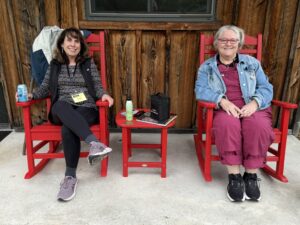
Luckily for us, Dale Marie Bryan (a fellow “Just Do It!” participant and now my dearest friend) kept us on task. Dale organized morning writing sprints, afternoon writing sprints, once a month read-alouds and a goal-setting googledoc. The read-alouds not only helped us revise, it also enabled us to truly get to know each other’s work.

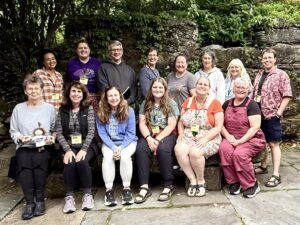
Chris and Sarah attended many of these sessions and often wrote and read right alongside us. They also offered more “Just Do It!” classes and continue to host inexpensive monthly online sprints. (For more information about these, message Chris on FB.) We also invited the next group of “Just Do It” graduates to join us for sprints and read-alouds. And after two years of meeting online on a regular basis, we have definitely bonded. So much so, that when Chris asked if any of us would like to attend a writing retreat at the Highlights campus, fourteen of us said  ABSOLUTELY YES!

At first, I didn’t think I could go. It’s quite a shlepp from Colorado to Honesdale. But the stars aligned. I was already going to NY the week before for my niece’s bridal shower. After spending a few extra days visiting family and friends, I rented a car and drove to Pennsylvania.

Spending time at the Highlights campus is always magical. Just ask anyone who’s been there. With the idyllic wooded setting, the cozy cabins, and the delicious farm-to-table cuisine, you can’t go wrong. This was my third time. However, the other two workshops I attended were mostly with people I didn’t know. It took a few days to connect and build trust. Gathering with the “Just Do It!” crew was a totally different experience.
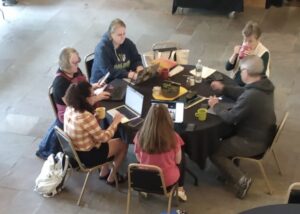


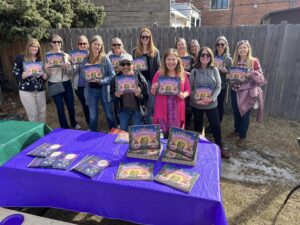
The minute I arrived, I felt like I was at a family reunion. Or a getaway with camp or college friends I hadn’t seen in a long time. There were hugs and exclamations of glee. And after the initial thrill of finally being together in-person, we immediately got to work. Because that’s what we do when we’re together – WE WORK ON OUR STORIES!

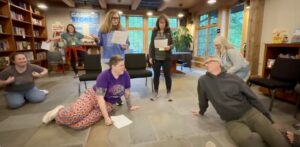
And there was more. Sarah offered inspirational talks and morning yoga. Author/illustrator Daria Peoples joined us and did an art exploration. Chris asked if we’d like to workshop our manuscripts “theater-style” in the evenings. This entailed printing out 500-1000 words of a manuscript that contained a great deal of dialogue. We made multiple copies, highlighted (pun intended) individual parts and passed out the “scripts.” After an initial reading, people were assigned a role and got up and acted out the scene. Wowwy kazowwy! We were able to see our work in a totally different way. Some scenes needed more movement, heightened action, deeper emotion. Others needed a bit more description or a transition or two. We were all mesmerized by this exercise. We gasped at the dramatic pieces and laughed hysterically at the humorous ones. What a great editing tool! If you’d like to participate in one Chris’ future workshops, check out this link:https://www.theatercampforwriters.com/
I have to say, except for bidding farewell to the ridiculous number of ticks that had recently burst onto the scene, it was sad to leave. Sort of.  We were heading home, but we also knew we’d be seeing each other again online the following week. Because the “Just Do It!” community is unstoppable!
If you’d like to take Chris and Sarah’s class, the next one starts in October. https://www.highlightsfoundation.org/workshop/just-do-it-your-collaborative-support-group-for-finishing-your-draft-fall/.

And by the way… I did finish my manuscript. Stay tuned!



1 Comment

Filed under craft advice, critique, Motivation, REVISION, Revision process, Rondi Frieder, Uncategorized

The Power of a Reading Buddy

By Susan Wroble

Seven years ago, our pup Nella was recruited for a job.

Nella, a black lab mix bred by Canine Companions.

Julie Neitz Wielga directs Partners in Literacy, a non-profit that creates communities of readers in schools. She matches up each student with an adult reading buddy, and the two meet weekly to read and discuss carefully chosen books. It a powerful—and highly successful—model for developing literacy.

But one student needed more.

Julie had worked with Rob in 4th and 5th grades, and he was going into 6th in a combined elementary/middle school. Rob was the type of kid who was always out of his seat, always bouncing up to get water or wander the halls, always heading off to talk to teachers instead of the other students. The type of brilliant kid who fails classes. The type of kid who doesn’t read because he can’t sit still. For this student, a regular reading buddy hadn’t been enough.

Julie thought that a dog might be the key. She knew that our family raised service dog pups , and we had kept Nella when she didn’t graduate for medical reasons and had worked to certify her as a therapy dog. In the summer before Rob started middle school, Julie took me on a tour of the school and we brainstormed how reading to Nella might work for this specific student. When I spotted a gigantic bean bag chair, we had a plan.

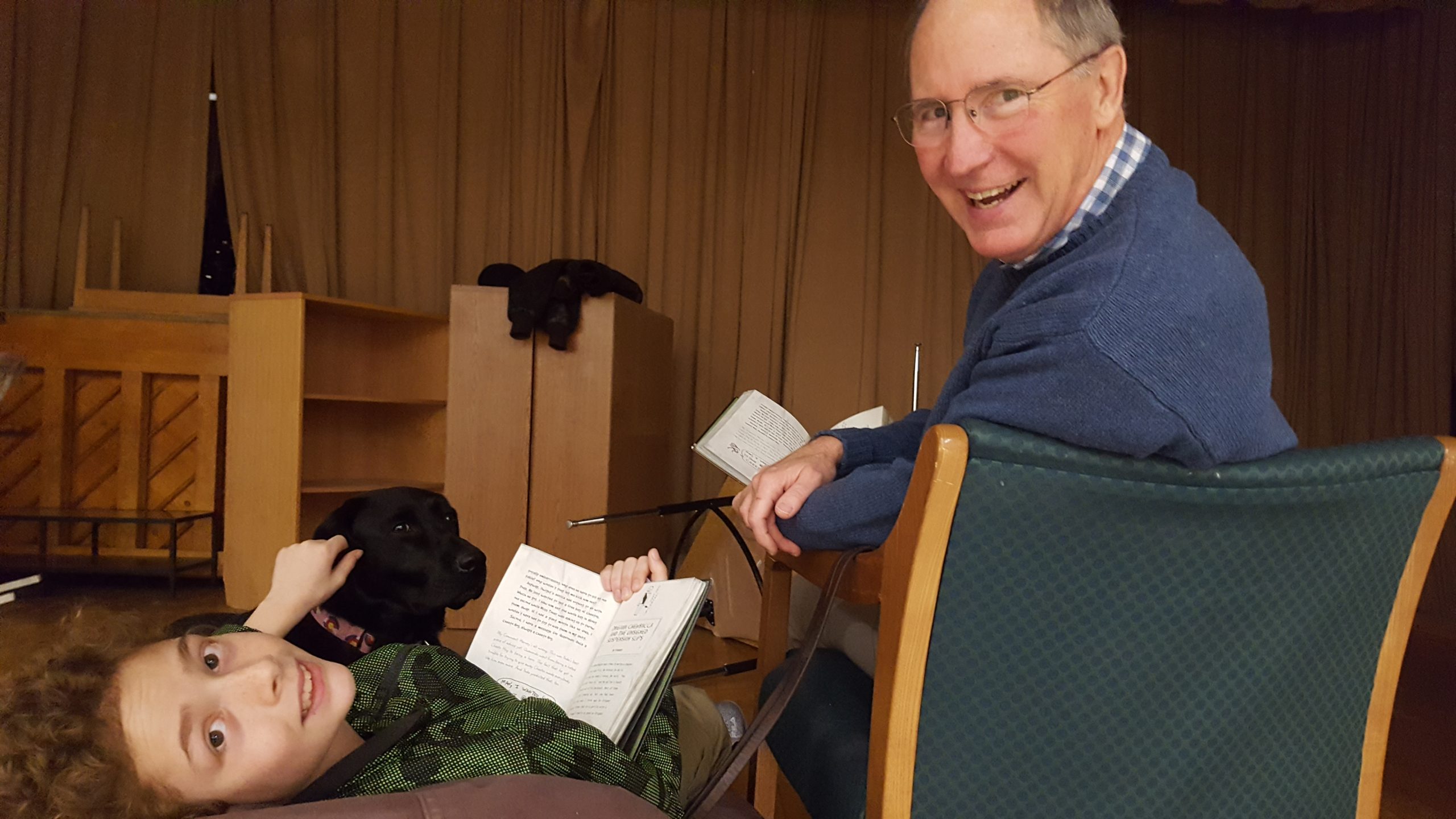
Nella and either my husband or I would head to the school library to pick up the books, then meet Rob at the chair, which we had positioned in a quiet corner of the auditorium stage. Rob sank into the chair. And Nella—all 55 pounds of her—jumped right of top of Rob, snuggled in, and listened to him read. It’s close to impossible for a student to spring out of their seat with a reading buddy providing that much pressure and weight and support.

Rob on a bean bag chair with Nella on his lap, and Guy Wroble


One of the secrets of Partners in Literacy is the books, chosen specifically for each student. To start the year, Julie chose Rain, Reign by Ann M. Martin, a book about a neurodiverse kid and a special dog.

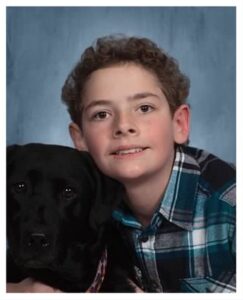
Julie’s idea paid off. Rob’s reading level jumped about three grades that year. Each week for two years, he read to Nella. He got to school on time, even early, to not miss the reading sessions. In his school photo, there’s a second face, a black furry one.

School photo of a boy with a black dog.

School photo of Rob with reading buddy Nella

Then Rob and his mom moved out of state. But that particular bond proved too strong to break. He called often. We zoomed. And each year when Rob was back in the state, we would get together—and Nella would snuggle right in.

School remained a challenging fit for Rob’s neurospicy brain. He ended up in an on-line school. Making it through high school was often in doubt.

But this year, he graduated. And we celebrated. Sometimes reading buddies are for far more than reading. Sometimes, they change lives.

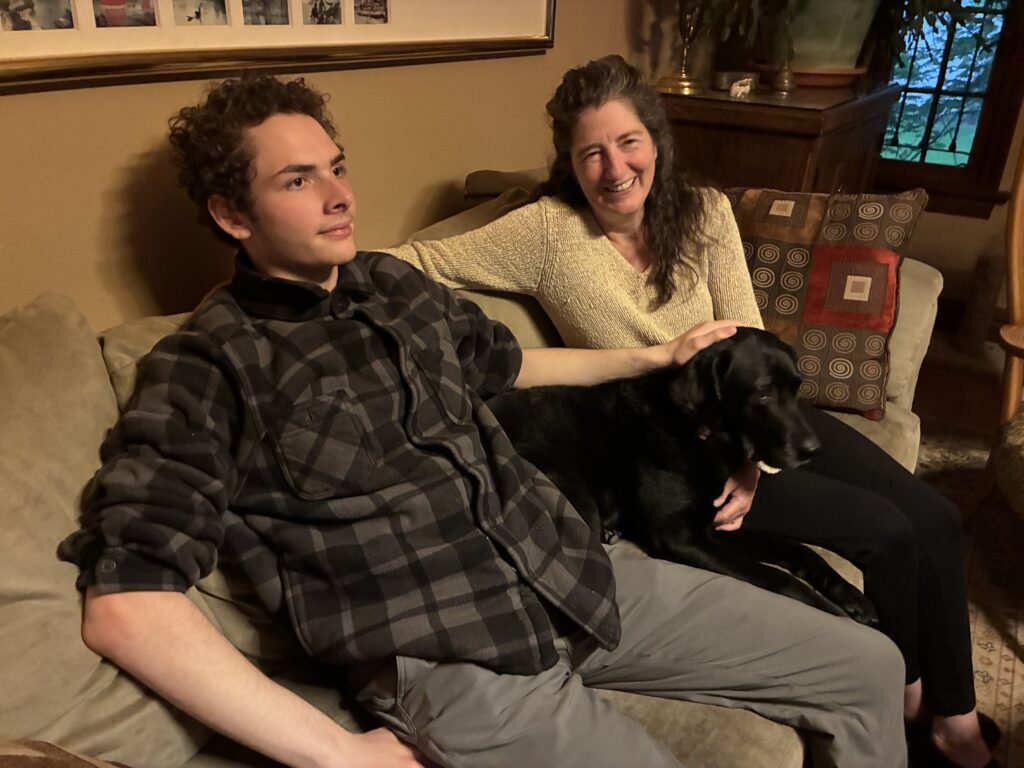
Rob, Nella and Susan seven years after becoming reading buddies with Partners in Literacy

For more information:

Partners in Literacy’s website and an earlier Writer’s Web post.

Article on the science of reading to animals

Rain, Reign by Ann M. Martin — a book that Rob talks about still.

5 Comments

Filed under 2025, Literacy Program, Partners in Literacy, Susan Wroble

Just the Right Word: The Joys of a Good Thesaurus

Many years ago, I attended a writing class with the incomparable Melanie Crowder that completely changed the way I wrote. That class opened my eyes to an entire new world, and at the time it was so far over my head—and was so brilliant—that I knew I was getting graduate-level craft techniques when my writing skill set was still somewhere at the high school level.

Melanie talked about word choice. Specifically, she talked about dialogue. What stuck with me was the insight that a character’s words should reflect their personality. A shy, withdrawn character would use softer sounds and would avoid using words with a lot of hard K and G sounds.

After that class, a thesaurus—first Roger’s, then the online Merriam Webster’s—became an essential part of my writing practice. I love searching for just the right word, with all its nuance and complexity of meaning. I’ve found that that those word searches have the added benefit of  being able to integrate words with poetic devices, like alliteration, assonance, and consonance.

But for writers, a generic thesaurus often isn’t enough. One of my favorite thesaurus-like resources has been linguistic professor Beth Levin’s ENLISH VERB CLASSES AND ALTERNATIONS: A PRELIMINARY INVESTIGATION.While I can not tell you what a verb alternation is, I do know that Prof. Levin’s lists are priceless. For my upcoming picture book DAWN CHORUS: PROTECTING BIRDSONG AROUND THE WORLD (Holiday House, 2026), I featured a variety of endangered birds, and was searching for a whole lot of different words that described the emergence of early morning birdsong. And the list I needed was there, under “Verbs of Sound Emission.”

This is a book that you can open to any page and find unexpected gems. There’s “Verbs of Social Interaction” with subclasses for meet, marry, correspond, talk and chitchat, or “Verbs of Removing” with its subclasses of remove, banish, clear and wipe, or “Verbs of Gestures and Signs Involving Body Parts” its wink and crane and curtsey subclasses. Writers often strive to reduce their use of adverbs, and make their writing more crisp and descriptive. In Latin, thesaurus” means “storehouse” or “treasury”, and this book is indeed a treasure.


Another treasure that should be on every writer’s shelf is Angela Ackerman and Becca Puglist’s best-selling THE EMOTION THESAURUS. For each emotion, there’s a list of physical signals and behaviors, internal sensations, mental responses, long-term responses, signs that the emotion is being suppressed, other emptions that this might escalate or de-escalate to, and associated verbs.

Ackerman and Puglist didn’t stop with emotions. Under their Writers Helping Writers® brand, they have an entire thesaurus collection with the goal of help writers master description and learn to show, instead of telling. There are thesauruses for settings and conflict, for occupations and character traits, and emotional amplifiers and wounds. And for those who would rather search online, all their works are available via One Stop for Writers. You can check it out with a two-week free trial, or sign up for monthly, six-month or yearly rates (currently $11, $60, or $105).


Another phenomenal resource for finding just the right word is the University of Miami at Ohio’s collection of collective nouns. This list is amazing not just for its depth, but for the fact that it includes when the word was first used (and the spelling at the time). A dissimulation of birds, for example, has been in use since the 1560s.

And, of course, there is the OneLook Dictionary and Thesaurus, a program that you can either use separately or install to work with your Google Docs. What I love about the OneLook Thesaurus is that it provides synonyms by part of speech, so if you were starting with a verb and looking for a relative adjective or noun, this one is great. For the poets, it will also restrict the lists by meter. For example, if you start with the word “soar” and wanted a related trochaic word (stressed, unstressed, unstressed beats), it might suggest “towering”.

Two thesaurus-related books for kids are also on my shelves: Tara Lazar’s ABSURD WORDS and Jen Bryant’s THE RIGHT WORD: ROGET AND HIS THESAURUS, illustrated by Melissa Sweet.


ABSURD WORDS is subtitled “A Fun and Hilarious Vocabulary Builder for Future Word Nerds” and in it, Lazar has created word squads with groups that share something in common. Not surprisingly, one of my favorite squads is “Once Upon a Time.” It’s words that have origins in stories—words like Pollyanna, jabberwocky, Lilliputian, and quixotic. The whole thing is just a delight to pick up, turn to any page, and read.


Jen Bryant’s THE RIGHT WORD is a nonfiction picture book that tells the story of young Peter Mark Roget, who made lists of related words in his desire to use the perfect word. Like many writers, I am indebted—and so, so grateful—for his work.
7 Comments

Filed under 2025, Susan Wroble, Uncategorized

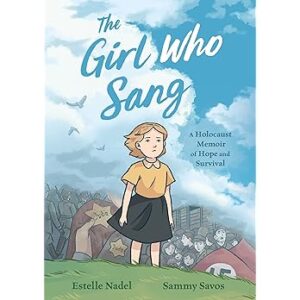
THE GIRL WHO SANG

Last year in November, my dear friend Estelle Nadel passed away. She was about to turn eighty-nine-years-old. In January of 2024, only months after her death, her graphic novel memoir, THE GIRL WHO SANG, came out into the world. This saga of Estelle’s (Enia in Polish) traumatic childhood as a young Jewish girl in Borek, Poland during the Holocaust, is moving, heart-wrenching, and powerful. And the story is greatly enhanced by the drawings of illustrator and storyboard artist, Sammy Savos.

Estelle’s story is one of life-threatening events, narrow escapes, and compassionate neighbors. She told it many times – in schools, on the news, and ultimately for the Steven Spielberg’s Survivors of the Shoah Visual History Foundation. She cried during every presentation. She couldn’t help it. Her life had been so difficult. But she was driven to keep going and often said, “People need to know this really happened… and that it happened to me. I have to do it now because I won’t be around forever.”

I was so happy when Estelle told me she had found both an agent and a publisher. I also told her that publishing a book, especially one with illustrations, could take years. At first, she wasn’t sure about it being a graphic novel. She didn’t want the illustrations to minimize the seriousness of what had happened to her. But her agent and editor felt like this was the best format to use in order to get her story into the hands of young readers. And after seeing the final product, I totally agree.

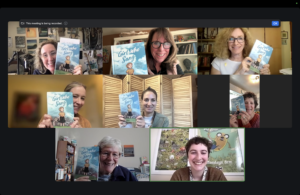
Last month, Estelle’s illustrator, Sammy Savos, did a Zoom presentation for one of my critique groups. I had been communicating with Sammy via email for many months and trusted that she would give us a good sense of her process. I hadn’t met Sammy in person or even spoken to her on the phone. Still, her heartfelt and appreciative correspondence made me think we were in for a treat. And boy, was I was right. Sammy’s talk was INCREDIBLE.

For a group of mostly kidlit writers, seeing and hearing about Sammy’s illustration process was mind-boggling. Not only did it take four-and-a-half years to complete the book, Sammy’s attention to detail was unprecedented. She had a very personal story to tell with many emotional components. Estelle’s father, sister, and one of her brothers were taken to Auschwitz and murdered. Her mother was shot in front of their small farm house. Estelle (Enia) and her one of her surviving two brothers were put in a jail cell as young children. They miraculously escaped and found their way to a neighbor’s house. That neighbor not only took them in, she hid them for over two years in the attic of her barn. And even when the war was over and Estelle and her remaining family members were liberated by the Russians, she still wasn’t safe. She and her brothers were taken to a displaced persons’ camp in Austria. But after a soldier heard Estelle sing, she and her brothers were given passage on a ship to America.

Sammy did an amazing job capturing Estelle’s life in Poland, giving particular attention to the buildings, clothing, and facial expressions of family members. She took great care in choosing the proper color palette to give the story a realistic tone. She made sure all the characters were proportional to one another, wore the proper clothing, and kept detailed notes about the timeline of events. Many of her drawings were inspired by the few photographs Estelle had from her childhood, and from her subsequent trips to Poland. Other information was gleaned by Sammy’s own meticulous research.

But most importantly, Sammy wanted to get the story right. She wanted to honor Estelle and her family, by getting the emotional and factual information as true as possible. She wanted young readers to learn about what had happened to Jews during the Holocaust by learning about a real person who had experienced it. Estelle and Sammy never met, but Sammy would often confer with Estelle by phone. And through it all, they developed a close bond. Sammy is in her twenties, Estelle was in her eighties. But the two connected as if they were related. As it turns out, members of Sammy’s family lived about an hour away from Estelle’s hometown of Borek, Poland before they came to America.

Estelle loved to sing, and I had the privilege of singing with her in our synagogue’s choir for many years. Whenever we were together, she always made time to ask me about my family and how I was doing. Despite her traumatic childhood, Estelle remained positive, active, and compassionate. She went on yearly trips to Poland where she participated in The March of the Living. She, and the grandson of the neighbor who had hidden her, gave talks in Polish schools about what had happened during the war. But her biggest claim to fame, Estelle’s signature line was telling everyone she cared about that she loved them. She didn’t want those words to go unsaid.

I am so thrilled that THE GIRL WHO SANG is out in the world to honor her legacy. Thank you Estelle, for telling your story, and thank you, Sammy, for bringing it to life.


6 Comments

Filed under 2024, Book Review, Graphic Novels, Interviews, Middle Grade, Nonfiction, Persistence, Rondi Frieder

RESEARCHING AGENTS: LEARNING AND MORE LEARNING!

Research, research, research. I have been doing lots lately. I’m in search of agents to query. This isn’t my first time. But yay me! After years of practice, I have become a quick-study combing through online resources: Manuscript Wish List (MSWL), QueryTracker, PublishersMarketplace, AgentQuery, Reedsy Marketplace, agent websites, interviews with agents, etc. Researching agents is being a detective – double-checking information; sleuthing for key words and phrases to find ones that fit the theme, plot, voice and vibe of my picture book and young adult novel; and running through agent’s social media posts.

One thing has stayed the same. It’s very tedious work. Very!! And there is no short cut. But I am always learning, especially when I see unfamiliar words and phrases on MSWL Some I need to know; others pique my curiosity. So, I thought I would share my latest “glossary.”

AYKB – Stands for “As you know, Bob…,” a technique writers often use to reveal important background information without taking readers out of the story.

BAME – Stands for Black, Asian, Minority Ethnic (writers).

Complex dynamics – Can mean complex characters or dynamic relationships between characters. When creating “complex dynamics,” here are tips for creating your characters: Find out what matters to them. Free write, play with characters to understand their complexities. Explore their backstory. Use characters’ surroundings to develop them.

Dark academia – Set in an elite school with old, crumbling gothic architecture, a dark library, eerie common rooms. Students wear uniforms and enjoy discussing art, literature, philosophy. Typically, there is one group of students that set themselves apart – by choice or through prejudice. Recommend: THE RAVENS (series) by Kass Morgan.

Dead genres – In the words of an agent, “I want the genres everyone says are dead. There is absolutely still room for ‘dead’ genres.”

DEAI – Stands for Diversity, Equity, Accessibility, and Inclusion.

Epistolary novel – Fiction written in the form of letters or other documents, such as emails, journal entries, texts, etc. Recommend: YOURS FROM THE TOWER by Sally Nicholls

Escapism – Stories with big characters, high stakes, and ideally, a happy ending. Recommend: DRAGONFRUIT by Makiia Lucier.

Fabulism –Stories that have fantastical elements entwined with the everyday perfectly ordinary – and don’t explain why. Recommend: THE ASTONISHING COLOR OF EVER AFTER by Emily X.R. Pan.

HEA – Stands for Happily Ever After.

Head hopping – When a writer hops between different characters’ perspectives (“heads”) within the same scene.

Intersectionality – Describes the way people’s social identities can overlap. Coined by Columbia law professor Kimberle Crenshaw: “It’s basically a lens, a prism, for seeing the way in which various forms of inequality often operate together and exacerbate each other.”

LitRPG – Stands for Literary Role-Playing Games, a genre combining the conventions of computer role-playing games with science fiction and fantasy novels. Recommend: Clan Dominance: The Sleepless Ones 1 by Dem Mikhailov.

Lower YA – category of young adult fiction aimed at ages 11-13. Typical elements: 1) Likeable protagonist with hints of heavy family topics/issues. 2) Mostly happy, resolution filled ending. 3) High school setting and first love type romance. Recommend: LUCKY IN LOVE by Kasie West.

Middle YA – category of YA aimed at ages 14-16. Typical elements: 1) Traumatic protagonist backstory. 2) Protagonists have a clear identity outside of their family. 3) More diverse, dynamic supporting characters. 4) Romantic relationships with more intimacy and meaning. Recommend: THE NAMES THEY GAVE US by Emery Lord.

Upper YA – category of YA aimed at ages 17+. Typical elements: 1) Protagonist out of high school or close to graduating; navigating post high school life; could be living on own. 2) Deeper introspection of protagonist’s flaws, strengths, wants. 3) Higher stakes and consequences for protagonist’s actions, decisions. 3) Romantic relationships with physical intimacy and/or focusing on long term. Recommend: THE REAPPEARNCE OF RACHEL PRICE by Holly Jackson.

Message novels – The author has a specific agenda – a message. Written to specifically promote an idea or concept.

Mirrors, windows and sliding glass doors – Dr. Rudine Sims Bishop, known for her groundbreaking research and advocacy for diversity and representation in children’s books, pioneered the concept that all readers must experience “seeing” themselves (mirrors), different perspectives (windows) and “stepping into” the experiences of others (sliding glass doors).

Selkies – Mythological creatures from Scottish folklore. They shapeshift between seal and human forms by removing or putting on their seal skin. Recommend: TIDES by Betsy Cornwell, SEVEN TEARS INTO THE SEA by Terri Farley.


Mind-boggling? Sure is. Every phase of writing is mind-boggling. But I keep soaking up support, like the recent advice from one of my author-mentors: “Work hard, work harder. What comes will come.”


5 Comments

Filed under Agents, Karen McChesney, Main character, Marketing, Motivation, Persistence, Picture Books

Making a Marketing Plan that Works for You

By Susan Wroble

Marketing. It usually fall pretty low on the list of things that KidLit creators want to do. But in a series of webinars this spring for Rocky Mountain Chapter of SCBWI, author Jessica Speer set out to change that mindset. Marketing, she noted, has evolved from an approach that focuses on market sales to one that values the audience as partners—an approach that prioritizes authenticity, value and trust.

Jessica’s Marketing Plan 101 started with a simple exercise: think about the ways you market yourself and your book, and add ways you want to try. Then think about what you like to do off that list, and what you think works best for you.

With that in place, Jessica recommended a five-step plan:

  1. defining your target audience,
  2. defining goals and making them measurable,
  3. developing a timeline and budget,
  4. adding action steps
  5. and at the end of the year, review, modify, and start over!

A measurable goal might be something like “raise awareness of my books by appearing on five parenting podcasts” while an action step might be something like “check Podmatch weekly to make connections.”

In the second webinar in the series, RMC members shared how they started putting some of that plan into place, and what has worked for them. Writer and poet Michelle Schaub said that she now has a reminder to reach out to her publisher twice a month, letting them know of good news.

Author Beth Anders with copy of book AN INCONVENIENT ALPHABETBeth Anderson loved the idea of scheduling marketing items on the calendar, and the idea of linking things. She noted that many classroom lessons start with quick, easy videos. Her promotional group has a YouTube channel with information for teachers, and one of her videos was a short (1.5minutes!) question of “What Would You Do?”, a springboard off her INCONVENIENT ALPHABET book that invited students to write persuasively. She adds those videos to the book page, to her podcast, to the teacher guides… all with the goal of reaching and assisting teachers.


Roxanne Troup shared a simple, easy tip—to go back through old blog posts and add “Alt Text” to all the images. Originally developed as a description of images for the visually impaired, Alt Text can link the image to a description—and to your name as author and the book title.

And when your book fits into some niche market, as Roxanne’s MY GRANDPA, MY TREE AND ME did with agricultural education, she recommends sending out pre-publication emails. Rachel’s template was to ask if they “might be able to help get the word out about this book through the [program name].” In her email, she provided a link to the book itself, teacher guides, and the publisher’s sell sheet as a handy way to pass along information about the book. Jenny Elder Moke noted that for her teacher guides, she included a biography, the book pitch, research links, and potential classroom activities.

In terms of book publicity, Lisa Cobb, Malia Maunakea and Lynn Becker all had luck reaching out to local newspapers or magazines of their alma maters. Beth recommended asked the publisher for their marketing plan, and then focusing efforts of the things they were not doing.

One technique for getting publicity, especially if you are a subject matter expert, is through Connectively (formerly HARA: Help A Reporter Out). The “lite” version is free, and allows you to browse the queries, searching by keyword, and send up to ten pitches a month.

Jessica noted that repurposing is a simple but effective way to optimize your website and social media presence. She might aim for at least one new article a month, but she will also update an older article to share again, or share in another place (LinkedIn, or Facebook, or a newsletter). And she ended with a quote from marketing guru Seth Godin, which reframed the idea of marketing for me, replacing at least some of my dread with anticipation:

“Our job is to connect with people , to interact with them in a way that leaves them better than we found them, more able to get to where they’d like to go.”

3 Comments

Filed under Marketing, RMC-SCBWI, SCBWI, Susan Wroble

Hosting a Writing Salon in Montreal!

About a month ago, my son Noah asked me if I’d be interested in teaching a writing class for his friends. He lives in Montreal, and my husband I would be visiting him over Memorial Day weekend. Noah has been hosting “salon-type” evenings at his apartment ever since the pandemic. Montreal had an eight o’clock curfew back then,  and in response to this, Noah and his extremely creative friends, began gathering in small groups for events at their apartments. They offered everything from jazz jams to yoga stretching to candle-making. And if the session ran past curfew, many of them unrolled their sleeping bags and spent the night.

I told him I’d be happy to teach a class. After all, I am a teacher and I write almost every day. But my expertise was in elementary education. And I write children’s books. I needed to create an activity that would appeal to a group of international thirty-somethings, many of whom work in the tech field.  Hmm…

I thought about the variety of writing workshops I’d attended over the years. Most of them focused on plotting tools, character arcs, and world building. These were great, but I needed something with more universal appeal. Something that might inspire poetry, song-writing, or journaling. I thought about the prompt intensive I took with Andrea Wang: (https://inthewritersweb.com/2022/12/the-stories-hidden-inside-you/) and the revision workshop with Kate Messner: (https://inthewritersweb.com/2024/03/highlights-from-the-2024-scbwi-winter-conference/). Both of these classes had us tapping into childhood memories to spark the stories within us.

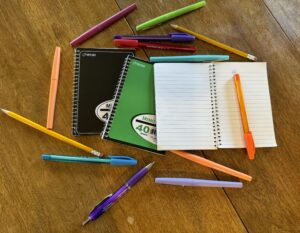
I went through my notes and came up with a variety of prompts, starting with childhood memories and moving to present day experiences. I asked my attendees to bring a blank notebook and their favorite writing implements. (I brought extra of both, knowing some people were rushing over from work to the event.) By 6:30, there were 17 people gathered in my son’s living room. They all settled in on couches, chairs, pillows, and the floor, and looked like they were ready to write.

The prompts would be five minutes in duration. I began by saying that some of the prompts would resonate, while others would not. I told them not to worry. This was not a school assignment. There would be no critique and no grades. I invited them to write poems, draw pictures, or make lists. I wanted them to enjoy themselves. I also told them the writing would get easier as we progressed.

We started with the question: “What is your earliest memory?” People stared at their notebooks. Others looked at the floor or the ceiling, while some got right to work. Eventually, the pens and pencils started moving. Everyone was slowly, but surely, getting into the flow. The teacher in me was thrilled to see my “students” scribbling away.

To be honest, an hour of writing by hand can be tedious. Some people were literally wiggling their fingers in between prompts to loosen up the muscles. I told them writing by hand was important for this fast-paced activity. It made it harder to edit and forced them to keep going. They understood this and before long, were immersed in their writing and flipping through pages in their notebooks. It was going well!

I had prepared twenty prompts and chose the following eleven because of our time constraints.

  1. Describe the house or apartment and neighborhood you grew up in. Use your senses.
  2. Tell us about a memorable family trip. Where did you go? Who was there? Include as many details as possible.
  3. Who was your first real friend growing up? What did you do together? Are you still in touch with this person?
  4. What is your favorite food and when was the last time you had it? Who prepared it?
  5. First crushes: Who was it? Give us details!
  6. Is there a story in your family that gets told over and over again? Tell us that story.
  7. Write about an amazing trip you’ve taken as an adult. Where did you go? Who was with you? Try to include all the five senses in your writing.
  8. Successes: Write about a time you achieved something extraordinary. How did it feel?
  9. Failures: Describe the most devastating failure or disappointment in your life. What happened and how did you handle it?
  10. What is the scariest thing that has ever happened to you? Write about it using lots of emotion.
  11. Think about the most hilarious thing that has ever happened in your life. Write about this now and try to reignite those feelings of fun, laughter, and joy.

This took up the full hour because 12×5=60 minutes! We had twenty minutes to share before the next session, which was being taught by my husband. Each person was invited to read what they had written or tell the story in their own words. Only one person felt uncomfortable doing this, but at the end, she came over and said this was one of the most powerful experiences she’s ever had. She had no idea these events and feelings were lurking inside her brain, waiting to burst forth.

Can you guess which prompts were the most popular? Earliest childhood memories, favorite foods, and first crushes were the winners. Two people even had the same favorite food story – a sweet, buttery, stuffed pastry from India. One person described a crush she had on a boy in kindergarten. Another spoke about how his mother sang to him every night before he went to bed. And one women described the house she lived in as a child, which was so vivid, I told her it would be the perfect setting for a middle grade novel.

As writers, we enjoy creating a compelling plot. We rejoice in finding the perfect verb to convey a feeling. And we love the challenge of imagining a setting with lots of sensory details. Did any of these attendees feel this way? As it turned out, the answer was a resounding yes. One person told me she was now inspired to take a writing class Another said he had no idea these memories would be so emotional for him. A third said he needed to do more prompts when he taught his adult writing class for immigrants. I was elated. Telling our stories is the universal human language.

By the way, my husband’s class was about how to plan a multi-day bicycle trip. Perhaps when our “students” go on a bike trip, they’ll take some time to write about it!


6 Comments

Filed under Andrea Wang, craft advice, Kate Messner, Rondi Frieder, Uncategorized

The Art of the Review (and why to do them!)

By Susan Wroble

In the post-conference survey from last years’ Rocky Mountain Chapter SCBWI’s annual conference, there was one request that really stuck with me. The attendee wrote “I want to learn how more about reviews. How to write them. How to get them.”

This resonated because I had struggled with reviews. While there are many reasons I now write them (learning the market, supporting my writing community, introducing people to books I love…), there is also the hope that one day, others will be writing reviews for me. Writing reviews feels a bit like dipping into karma.

I post most of my reviews on Amazon or Instagram, but Goodreads and Barnes and Noble are both great options, along with podcasts. While Amazon isn’t where I tend to buy new books, it is a place where numbers matter, and one of my goals is to make my reviews as effective as possible for book creators.

My process is fairly simple: I log into Amazon, search for the book I plan to review, then scroll down until I get to “write a customer review.” I give a short paragraph about why I loved the book. If it’s a picture book, I try to include a photo of an interior page, as well as a bit about the artwork—here’s an example with Patty Cisneros Prevo’s book TENACIOUS. I only write reviews for books that I can honestly and happily rate as five stars.

I’ve found that Instagram is a fabulous place to post reviews of books that I want to be able to find and reference easily later on—perhaps as mentor texts, like Roxanne Troup’s compare/contrast structure in MY GRANDPA, MY TREE AND ME, or as comp titles for a work-in-progress.

Taking it to the Next Level:

I’m always in awe of those people who have taken reviewing to the next level. I’d encourage you to take the time to read, follow and get to know these incredible reviewers, their sites, and their reviews and resources.

Bianca Schultz is founder and editor of The Children’s Book Review (TCBR). The Association for Library Service to Children (ALSC) has named TCBR one of the Great Websites for Kids. And no wonder—this amazingly user-friendly site provides lists by author, subject, age, and favorites (including board books, books on activism and diverse and inclusive books). And if that weren’t all, there’s the Growing Reader’s podcast, frequent book give-aways, interviews with authors and illustrators, and a rich trove of articles and writing resources, including this one on the art of getting your children’s book reviewed!

Children’s book expert Melissa Taylor operates the site Imagination Soup. More than 35,000 teachers, parents and librarians subscribe to the Imagination Soup newsletter. Her newsletters give book reviews and learning resources, and the highly searchable site gives books by genre, age and—my favorite as a former homeschooler—playful learning. Being included on Melissa’s incredible booklists provides a lot of exposure. Imagination Soup is a go-to site for lists — say you want a list of books to teach word choice, books in a series by grade-level, exceptional books with autistic characters… just about every possible list you could imagine is on this site! For reviews, Melissa includes a short paragraph about the book and a purchasing link.

If you write middle grade, Greg Pattridge is your guy! Greg runs the “Always in the Middle” site. His reviews provide a summary of the book, the book birthday and page count, “Five More Things to Like” and a bit about the author (and illustrator, when applicable). Greg has a great break-down by category, so if you are looking for MG graphic novels, or nonfiction, or sci-fi, for example, his site is an excellent place to search.

Greg lend his support to other middle grade reviewers with his Marvelous Middle Grade Mondays (MMGM) posts, where he links to several other middle grade review sites — and he makes it super easy to be included. To have your review of a MG book included in the MMGM line-up, all you have to do is email Greg at gpcolo (at) gmail (dot) com by Sunday night with a link to your blog and the title you are featuring, MMGM in the subject line, then schedule a post for a Monday.

Author and reading specialist Laura Roettiger doesn’t do traditional book reviews. Instead, each month she features one author or illustrator and their book on her blog. I was honored to be highlighted in November 2022. Laura’s process is that she sends her interviewees a list of questions and requests a photos to accompany the post. I can tell you that, from an author’s perspective, having an interview like this to be able to link to is a true gift.

So for those of you wondering how to start reviewing, there is no “right” way. Just start, and over time you’ll figure out what works for you! And if you are wondering how to get reviews, that’s easy. Lean into the karma of supporting your kidlit community, and gift them reviews.

2 Comments

Filed under 2024, Book Review, RMC-SCBWI, Susan Wroble

Highlights from the 2024 SCBWI Winter Conference

By Rondi Sokoloff Frieder

“Poetry inspires all other writing!” Joseph Coelho

“Go snoop in your protagonist’s bedroom.” Kate Messner

“Throw rocks at your characters!” Phil Bildner

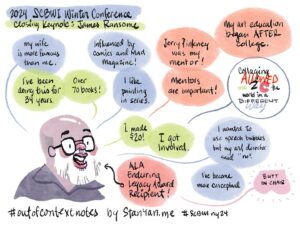
“There’s always more to learn!” James Ransome

 I recently had the pleasure of attending the SCBWI WINTER CONFERENCE in New York with my RMC-SCBWI buddies, Susan Wroble and Stan Yan. Susan and Stan are the dynamic co-regional advisors for the Rocky Mountain Chapter and spending time with them made the weekend extra-special. We went to a Broadway play, strolled through Central Park, ate in charming restaurants, and regularly checked-in to discuss our sessions.

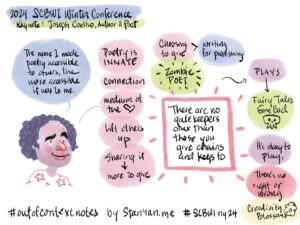
I’ve attended this conference before, but not in many years. I remembered being wowed by the inspirational keynote speakers, and blown-away by the impressive portfolio showcase. This year did not disappoint. Our opening speaker was the Children’s Poet Laureate from the United Kingdom, Joseph Coelho –  www.thepoetryofjosephcoelho.com. Joseph was extremely entertaining and drew us in with zany poetry prompts, rap writing, and tales of riding his bike through the countryside, collecting library cards (he has 213). His mission – to engage children in literacy. Here’s author/illustrator Stan Yan’s visual documentation of this presentation:

Our closing keynote was the award-winning illustrator (and sometimes author), James Ransome. James has published over 70 books for children, many with his wife, Lisa Cline Ransom. http://jamesransome.com. James’s vibrant use of color and innovative composition evokes an emotional response in the reader every time. His illustrations linger in your mind, long after you’ve turned the page. James’s passion for being a lifelong learner was infectious. He encouraged us to always take classes to hone our craft and told us to never stop creating.

But the highlight of the conference for me, were the “Creative Labs.” We all signed up for two, three-hour intensives in our genre – one on Saturday and one on Sunday.  In my case, these workshops focused on revising middle grade novels. My incredible teachers were Kate Messner, https://katemessner.com and Phil Bildner  https://philbildner.com.

In Kate’s REVISION HALF-MARATHON, she told us that “Revision is magical. You are shaping your manuscript into something TRUE!” She asked us to spend some time thinking about THEME. And once we figured out what that was, she suggested we post this in our workspace to remind us that theme must show up in every scene. She also set the timer and had us write about two things: “My novel is about… But underneath that, it’s really about…” I’ve done this exercise before and it is always enlightening.

Kate also talked about loglines and pitches and reminded us that we must write these in order to really know what our book is about. But the second part of the intensive, the heart of the workshop, involved snooping around in our main character’s bedroom! And man-oh- man, was this eye-opening. I thought I knew almost everything about my main character. But oooooh, there was so much more to discover, right in the most obvious place!

Coincidentally, the opening scene of my novel takes place in my protagonist’s bedroom. But after starting this exercise, I realized I didn’t have a detailed enough picture of what this room actually looked like. Kate asked us to consider the following: Does your MC have her own space or does she share? What’s in her closet and dresser? Are there books on a shelf? What are the titles? Stuffed animals? Collections of rocks, shells, baseball cards? Is she neat or messy? What kind of technology does she use? And my favorite… What is ON and UNDER her bed? Kate also had us make character circles, with inner circle friends vs. outer circle friends. Then she asked us how these circles changed throughout the course of the book – a very important component of most MG stories. Brilliant!

Kate loves charts and gave us a zillion ideas on how to make them. She suggested a chart to track important characters and themes in each chapter. A chart that monitors emotions and image systems. And finally, a chart that looked for the frequency of short sentences vs. long. She also suggested making a calendar and map of our setting. She even gave us chart paper to take home so we could start the work! This was a master class. I can’t wait to use some of these “magical tools to make something true!”

My second Creative Lab was with the dynamic writer and teacher, Phil Bildner. It was entitled “Breathing Life Back into Your Manuscript.” I had taken a class with Phil at another conference and I knew we were in for a treat. Phil’s session was extremely interactive. First, he had us working alone, then with one partner, and eventually three of us spent time creating a completely new story together! In the partner-exercise, we were asked to clean out our pockets; either in our clothing or from our purse or backpack. He asked us to use three of the found objects in a new scene in our novel. That’s when I literally struck gold. I found a gold candy wrapper that sparked an idea. Gold is now an image system that pops up throughout my novel.

Phil also had us reimagine an abandoned manuscript as a different genre. I scribbled down a variety of picture book ideas from a MG novel that has not sold. Phil also gave us a list of mentor texts to read and, more importantly, provided us with resources to combat the banned books movement: Authors Against Book Bans, Unite Against Book Bans, Book Riot, PEN America, We Need Diverse Books, and many more. He is passionate about this cause and inspired us all with his activism. Because if books didn’t matter, they wouldn’t be banned.

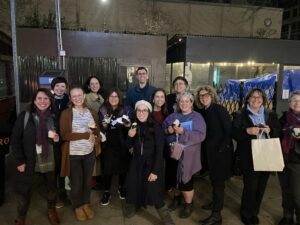
I also had the opportunity to have dinner “off-site” with the amazing Jewish Kidlit Mavens. I am in the Maven’s Facebook group, but hadn’t met these people in-person. Most of the authors/illustrators who attended were from the NY/NJ area. And what an impressive group – Liza Wiemer, Chana Stiefel, Ann Koffsky, Josh Levy, Kimberly Marcus, and Yevgenia Nayberg, to name a few. It was such a treat to spend the evening with these inspirational creators of books for children with Jewish content.

But the biggest takeaway for me was the strong sense of community we all felt by being together, in-person, with a common goal – to create the highest quality books possible for children. Oh, and one more thing… I had a very promising critique with an agent. Fingers crossed for a positive outcome!


4 Comments

Filed under Book Banning, James Ransome, Jewish Kidlit Mavens, Joseph Coelho, Kate Messner, Phil Bildner, SCBWI, SCBWI, STAN YAN, Susan Wroble, Uncategorized

Storytime, Early Literacy, and Bells. Oh My!

Most of us have heard of the Caldecott and Newbery medals – children’s book awards that have been around for, well, a VERY long time. But have you heard of the CLEL Bells? No? Take a seat, I’ve got a story to tell.

I’ve been a librarian, as of this summer, for 25 years. And in those 25 years, my job has changed quite a bit – in good ways and bad. But one incredibly satisfying way in which it’s changed is in the way children’s librarians view their work. While we still work hard to connect children with the right book at the right time, and help them grow a love of reading through storytime, we recognize now that our work goes beyond that. And a big reason for that shift in thinking came with the advent of Every Child Ready to Read.

Every Child Ready to Read (ECRR) is a framework created in the mid-2000s in a partnership between the Public Library Association and the Association of Library Service to Children (both divisions of the American Library Association). Using the most current research available at the time, it focused on how libraries could (and did) empower parents and caregivers to help their children get ready to learn to read later on. It helped librarians understand how the activities we did every day in our storytimes helped build early literacy skills, and gave us the language to talk to caregivers about these skills and how to encourage them at home.

It was a shift that wasn’t easy for some librarians. Storytime had always been about THE BOOKS, primarily. And while reading stories continued, now many of us were incorporating early literacy “tips” into our programs that explained more of the WHY we do what we do in storytimes: Why songs and movement were important learning tools along with books. Why we ask questions as we read stories. Why we don’t expect the children to sit quietly the whole time. How all of these things are building language skills and vocabulary knowledge and brain connections. Breaking this “fourth wall” and speaking directly to the parents was hard for many, but most of us practiced and got used to it. Because we know, WE KNOW, that this is important. The work we do was, and is, helping children get ready to read.

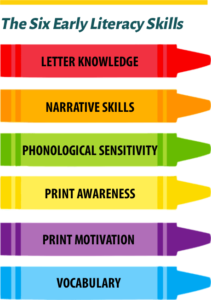
The first iteration of ECRR described six skills that young children needed to develop in order to make learning to read easier. They were:

  • Print motivation – loving books and reading, and therefore being motivated to learn to read;
  • Print awareness – understanding that print is all around us and is used for many purposes (in books, on signs, lists, letters,
    etc); knowing how print works (in English we read left to right, top to bottom);
  • Narrative skills – understanding how stories work (beginning, middle and end) and being able to tell stories and retell/describe events and make predictions;
  • Vocabulary – knowing lots of words!
  • Letter Knowledge – recognizing letters and knowing their names and sounds;
  • Phonological Awareness – being able to hear and play with the smaller sounds that make up words, like letter sounds and rhymes.

The second iteration, recognizing feedback from a lot of librarians that said that sharing terms like “phonological awareness” with parents felt… inauthentic (read: a little too highfalutin’) when we were trying to let parents know the simple benefits of singing with one’s child, turned the six skills into 5 practices that librarians could encourage caregivers to do with their children at home to build early literacy skills – all of which are things we do in storytime. The 5 practices are:

  • READ. Seems obvious, doesn’t it? But really, there is nothing better for building a future reader than reading or sharing books with them.
  • TALK. Recent research has shown how vital conversations are to growing a young child’s brain. They are learning language, how to communicate, vocabulary, social-emotional skills, and so much more.
  • SING. Not only does singing promote phonological awareness, but it also develops memory skills and grows vocabulary and language.
  • WRITE. Here it doesn’t mean just working with crayons and pencils and words. It means growing fine motor skills that allow us to hold a crayon or pencil. It means understanding that writing is used for more than just books, it’s also used to communicate in lists, signs, letters, and more.
  • PLAY. Children learn best through play, and that includes learning skills they can use when later reading – like building their imaginations, background knowledge about the world, and vocabulary.

One outgrowth of this shift was the creation of Colorado Libraries for Early Literacy (CLEL) which I had the good fortune to be involved with from its inception. Born in 2008, this organization, sponsored by the Colorado State Library, seeks to support libraries and librarians across Colorado in our work with young children and families. The organization has grown by leaps and bounds and now includes an annual conference attended by librarians many parts of the country.
One of the things CLEL realized in our early years is that nobody was recognizing books that were particularly good at supporting early literacy skills growth. As the center of storytime remains the book, CLEL wanted to create an award that would do just that. And the CLEL Bell Awards were born.

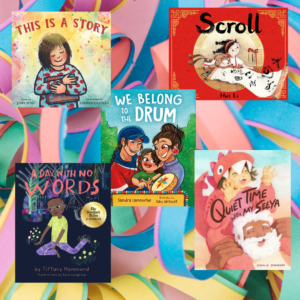
The CLEL Bells are an “annual recognition of five high-quality picture books that provide excellent support of early literacy development in young children.” There is one for each of the 5 practices above – READ, TALK, SING, WRITE and PLAY. Additionally, the committee creates an activity sheet to go along with each book to extend the learning. And without further ado, the 2024 winners, announced just a couple of weeks ago, are:

READ: This is a Story by John Schu and Lauren Castillo

TALK: A Day With No Words by Tiffany Hammond and by Kate Cosgrove

WRITE: Scroll by Hui Li

SING: We Belong to the Drum by Sandra Lamouche and Azby Whitecalf

PLAY: Quiet Time With My Seeya by Dinale Dabarera

The award has been in existence 10 years and all of the past winners are listed on the website, along with their activity sheets. In the first year the award committee, which I got to be a part of, also selected 25 “Silver Bell” awards to recognize 5 books in each practice category published in the prior 25 years.

Go check out these amazing picture books – and share with your little ones!

2 Comments

Filed under Awards, Best Books, Early Literacy, Mary Kuehner, Picture Books